Sound: the half of your video nobody budgets for
Viewers forgive soft focus but not bad audio. How sound is captured on set, what happens in the mix, and how to budget so your voice is heard.
Rich Prince Media · · 5 min read
Audiences will forgive a soft shot or an awkward cut. They will not forgive bad sound. Hiss, echo, a voice that drops in and out, wind tearing across a microphone: viewers click away within seconds, often without knowing why. Yet sound is the line item most often squeezed out of a video budget, or left to whoever happens to be operating the camera.
We think that is backwards. Here is why sound deserves its own place in your plan.
Why sound matters more than it seems
Picture is what people remember. Sound is what makes them believe it. A clean, close, warm voice makes a speaker sound credible. Room echo makes the same speaker sound distant and less sure of themselves. Music and the mix tell the audience how to feel, and when.
There is a practical point too. A great deal of video is watched on phones, often in noisy places. Clear dialogue that cuts through, and accurate captions for people watching with the sound off, decide whether your message lands at all.
Sound starts on set
The most important rule: record it properly the first time. Tools for cleaning audio in post have improved a lot, but they work best on decent recordings. They cannot fully rebuild a voice buried under a ventilation system or a passing truck without some cost to quality.
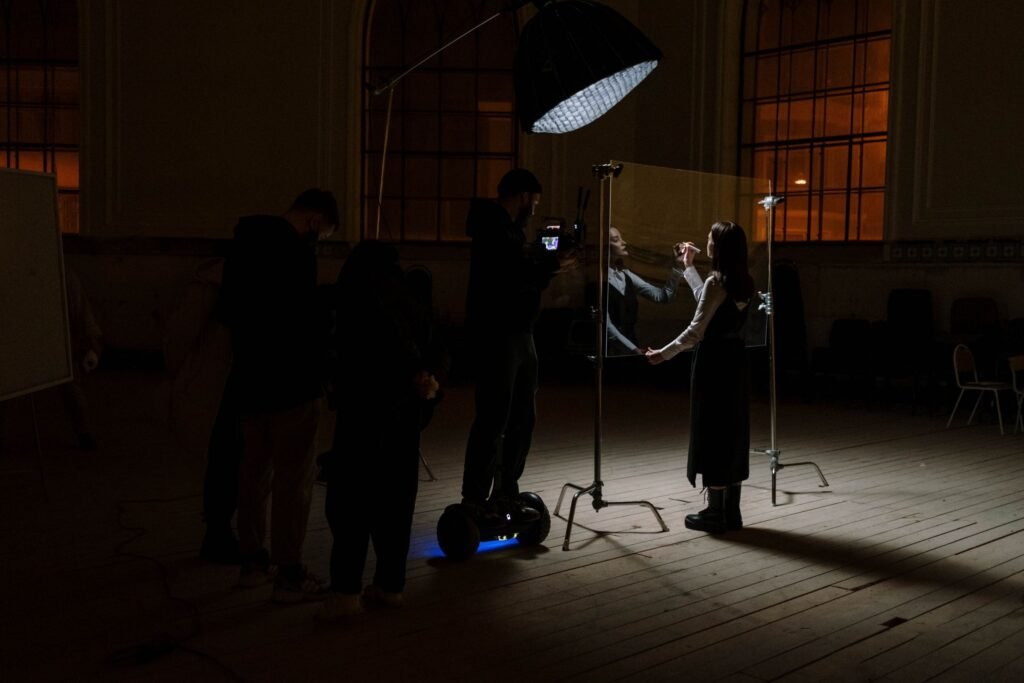
On our sets, sound is handled by a dedicated sound recordist. Their whole job is listening. That focus matters, because the camera operator is busy with framing and focus and is not wearing headphones on every take.
Booms and lavs
Two microphone types do most of the work:
- Boom microphones are directional mics on a pole, held just out of frame above or below the speaker. They capture a natural, open sound with some of the room's character.
- Lavalier microphones (lavs) are small mics clipped to or hidden in clothing, usually transmitting wirelessly. They sit close to the mouth, so they reject much of the background noise, but they can pick up fabric rustle if they are not placed carefully.
We often record both on the same take. The editor and mixer can then choose the better source, or blend them. It is cheap insurance.
The room
Before we commit to a location, we listen to it. Hard walls and glass create echo. Fridges, air conditioners, buzzing fixtures and traffic create constant noise that is easy to ignore in person and impossible to ignore in a recording. Part of our location scouting is simply standing in a room in silence and noting what we hear. Sometimes the fix is switching off the HVAC during takes. Sometimes it is moving furniture, adding blankets out of shot, or choosing a different room.
Room tone and wild lines
At each location, the sound recordist asks for thirty seconds or so of silence while everyone holds still. That is room tone: the natural background sound of the space, used later to fill gaps in the edit so cuts do not sound like holes. If a line is spoiled by noise, we may also record it again "wild", without picture, for the editor to use.
What happens in post
Once the edit is locked, sound goes through its own process in post-production:
- Dialogue edit. Choosing the best mic, removing clicks, breaths and noise, and filling gaps with room tone.
- Sound design. Adding effects and atmospheres: footsteps, doors, city ambience, movement for motion graphics. This is what makes a scene feel physical.
- Music edit. Cutting the track to fit the picture, on beats and phrases, so it feels written for the film.
- Mix. Balancing dialogue, music and effects so every element is clear and the voice always sits on top.
- Loudness and deliverables. Platforms and broadcasters have different loudness targets and technical specifications. We deliver to each, so your video does not sound quiet in one place and harsh in another.
Music licensing in brief
Music is part of sound, and it has its own rules. Using a commercially released song in a video generally needs permission from the owner of the composition (usually a publisher) and the owner of the recording (usually a label). In Canada, organisations like SOCAN handle performance rights, which is a separate matter. Production music libraries and original compositions are often simpler routes. Terms vary by use, so check the current licence terms, and get proper advice when the stakes are high. This is general information, not legal advice.
For artists, the situation is different. In a music video, the song is the soundtrack. The work is in clean playback on set so the performance syncs, and in making sure the final picture lines up with the master exactly.
How to budget for sound
A simple guide we give clients:
- Any project with people speaking on camera should have a dedicated sound recordist.
- Budget for a proper mix, not just levelling in the edit.
- Choose locations partly for how they sound, not only for how they look.
- Plan music early, including licensing, so the edit is not built around a track you cannot use.
- For podcasts, sound is the product. Treat the room accordingly.
Good sound rarely gets noticed. That is the point. Bad sound gets noticed immediately, and it takes the picture down with it.
If you are planning a project and want the sound to be as strong as the picture, we would be happy to talk it through. Get in touch.