Lighting is the difference you feel but cannot name
Why a well-lit frame feels more expensive and more confident, what the crew is doing during that long setup, and why the grade cannot fix bad light.
Rich Prince Media · · 5 min read
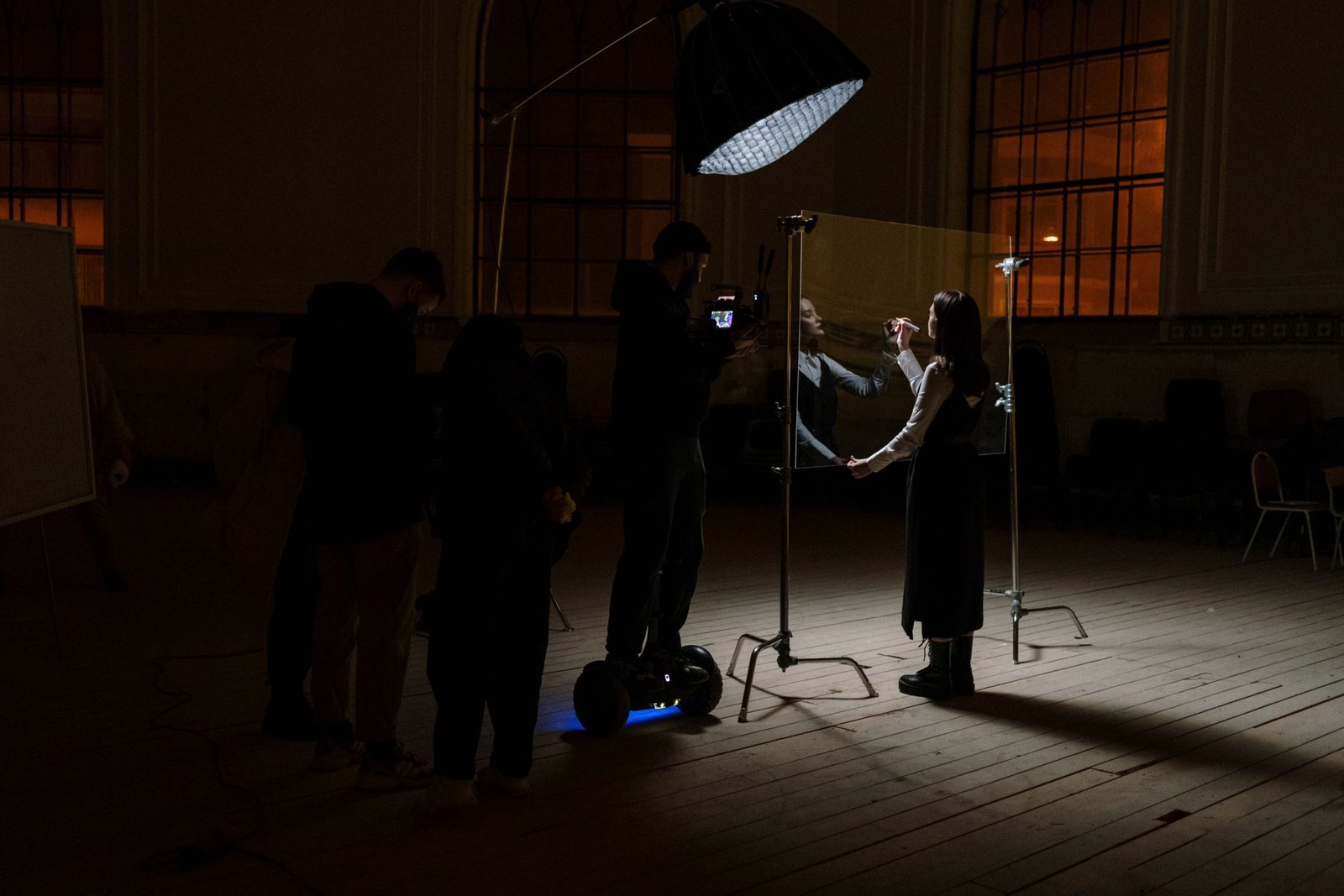
Show a client two versions of the same interview, one lit well and one lit poorly, and they will almost always pick the right one. Ask them why, and they often cannot say. "It just looks more expensive." "She looks more confident." "It feels like a real film." That is lighting doing its job: shaping how you feel about what you see, without asking for your attention.
On our sets, lighting usually takes more time than anything else. Here is why, and what is actually going on while you wait.
Light is direction, not just brightness
Modern cameras can see in remarkably low light, so it is tempting to think you only need enough light to expose. But exposure is the smallest part of it. What matters is where the light comes from, how hard or soft it is, what colour it is, and where it does not fall.
A face lit flat from the front, by a ring light or an on-camera light, looks evenly bright and strangely lifeless. Move the main light to the side, let a little shadow fall on the far cheek, and the face gains shape, depth and mood. Same person, same camera, different story.
The basic vocabulary
You will hear crews use these terms. They are worth knowing.
- Key light: the main source on your subject, usually set to one side.
- Fill light: a softer source, or a reflector, that lifts the shadows the key creates. Less fill means more contrast and more drama.
- Back light or rim light: light from behind that separates the subject from the background with a subtle edge.
- Practicals: lamps, screens, windows or neon signs that appear in the frame and are part of the look.
- Negative fill: black flags or fabric that take light away and deepen shadows. Removing light is as important as adding it.
- Hard and soft light: a small source, like direct sun, gives sharp shadows. A large, diffused source, like an overcast sky or a big softbox, wraps around the subject gently.
Why lighting takes time
Clients sometimes watch a crew spend an hour on a setup and wonder what could take so long. Here is some of what is happening:
- The gaffer, who heads the lighting department, is building the key, fill and back light to match the look agreed in the treatment.
- The grip team is rigging stands, flags and diffusion so light falls only where it should.
- Someone is lighting the background so it supports the subject without competing with them.
- Colour temperature is being matched, so daylight from a window and warm light from a lamp do not fight each other, unless that contrast is the intent.
- The setup is being tested on camera with a stand-in, because what the eye sees and what the sensor records are different.
Then everything has to be safe: cables taped, stands weighted, power distributed properly. It is not glamorous, but it is what lets talent walk on set and perform without worrying about anything except the performance.
Working with daylight
Daylight is beautiful and free, and it never stops moving. A window that is perfect at 10 a.m. may be blasting direct sun by noon and gone by four. For exteriors, time of day changes everything. We plan around it in pre-production, using sun-tracking tools and scouting at the hour we intend to shoot.
Large HMI fixtures exist largely because of daylight. They are powerful daylight-balanced sources that can stand in for the sun, stretch a scene beyond the real window of good light, or hold continuity when clouds roll through. LED fixtures have taken over much of the rest of the job, being cooler, lighter and adjustable in colour. Our kit carries both, along with the grip to control them.
Lighting tells the audience what to feel
Every lighting choice carries meaning.
- High key (bright, low contrast) reads as open, clean and optimistic. Common in corporate and lifestyle work.
- Low key (dark, high contrast) reads as serious, dramatic or intimate. Common in music videos and storytelling.
- Warm light suggests comfort, memory or evening.
- Cool light suggests something clinical, nocturnal or modern.
- Motivated light, which appears to come from a real source in the scene, feels natural even when it has been carefully designed.
For an artist, lighting can help define a visual identity. Warm, sculpted light suits one kind of artist. Hard, coloured, graphic light suits another. For our work with Gem Shadou, the styling was gold-toned with mirrored twin compositions, the kind of look where lighting and art direction have to be planned together.
Lighting and the grade
A common misconception is that a poorly lit image can be fixed in post. The grade can adjust colour, contrast and exposure, and it can do a lot. What it cannot do is create direction, shape and separation that were never there. A well-lit image gives the colourist room to refine. A poorly lit one forces them to rescue. Our post-production team will always tell you the grade starts on set.
What this means for your budget
If you have to trim somewhere, we would generally rather simplify the camera package than the lighting. A modest camera with excellent lighting usually looks better than a top-end camera with poor lighting. The same is true in photography: the light makes the portrait.
You do not need to understand every lighting term to get great results. You just need a team that cares about it as much as you care about how your brand or your artist looks. If you want to talk about the look for your next project, we would be glad to hear from you.
