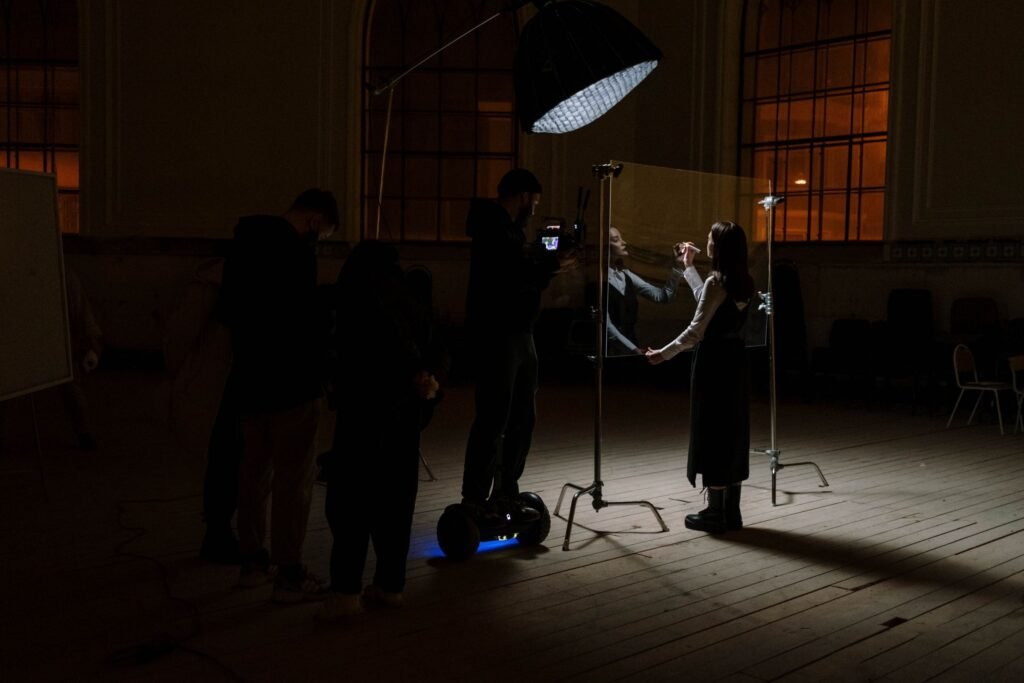
Pre-production is where your video budget is won or lost
Most of a shoot's budget is protected or wasted before the crew arrives. Here is what good planning covers, and the decisions that move cost the most.
Rich Prince Media · · 5 min read
Clients often assume the expensive part of a video is the shoot day: the cameras, the crew, the lights. In our experience, the money is decided much earlier. By the time a crew arrives on set, most of the budget has already been either protected or wasted, depending on how well pre-production was done.
After three decades of producing, we would put it simply: an hour of planning saves several hours on set, and an hour on set costs far more than an hour at a desk.
Why shoot days are where money disappears
A shoot day is the most expensive unit of time in production. You have a full crew on the clock, equipment running, talent booked, a location paid for, catering and transport. If a decision has not been made before that day, it gets made on set, with everyone waiting.
Consider what one unresolved question costs. The director and the client debate wardrobe for forty minutes. Twenty people stand around. The light changes. The schedule slips, and the last scene of the day gets rushed or cut. Nothing went "wrong", and yet the day lost a real share of its value.
Overtime is the other quiet budget killer. Crew day rates usually cover a set number of hours, and going past them gets expensive quickly. Most overtime traces back to a planning gap: an underestimated setup, a company move nobody timed, a location that was never scouted at the right hour.
What good pre-production actually covers
Our creative development work moves through a set of stages. Each one locks a decision so it does not have to be made under pressure later.
- Brief and objectives. What the video must achieve, for whom, and where it will live. This shapes everything, including aspect ratios and running time.
- Concept and treatment. The creative idea, written and illustrated, approved before money is spent on execution.
- Script. Every word locked, ideally with legal or brand sign-off before the shoot rather than after.
- Storyboard or shot list. Every setup planned, so the crew knows exactly what gear and time each one needs.
- Budget. Built from the shot list, not guessed from a round number.
- Locations. Scouted, photographed, and checked for power, parking, noise and permissions. Our location scouting page explains how we approach this.
- Casting and talent. Booked, with wardrobe confirmed and usage rights agreed in writing.
- Schedule and call sheet. The day planned in blocks, with travel, setup, meals and wrap all accounted for.
The decisions that move the budget most
Some choices have an outsized effect on cost. Making them early and deliberately is where the savings live.
Number of locations
Every company move (packing the gear, driving, unloading, relighting) can take hours. Two scenes at one location are almost always cheaper than two scenes at two locations. A good producer looks for a single place that can play several roles. A building with distinct rooms, a usable exterior and good parking can sometimes save an entire shoot day.
Daylight and time of day
If a scene needs golden hour, the schedule has to be built around a window that may last well under an hour. Plan it on paper with a sun-tracking app and a scout at the right time, and you get it. Guess, and you may be paying for a second day.
Talent and usage
Actor and model fees often depend on how and where the footage will be used, and for how long. Agree usage before the shoot. Renegotiating after a campaign is already live is rarely cheap.
Music
If your edit depends on a specific song, find out early what licensing it needs. Using a commercially released track in a video usually requires a sync licence for the composition and a master use licence for the recording, which is separate from the performance royalties that organisations like SOCAN administer. It can be slow and costly, and sometimes it is not possible at all. Check the current requirements for your use, and plan an alternative.
Permits and insurance
Shooting on public property in Toronto or across Durham Region may require a permit from the municipality, and applications have lead times. Check the current process with each city's film office well before your date. This is general guidance, not legal advice.
A quick test for your next project
Before you approve a shoot date, ask your production team these questions. If any answer is "we will figure it out on the day", that is a budget risk.
- Is the script locked and approved by everyone who needs to approve it?
- Has every location been scouted in person, at the time of day we will shoot?
- Is there a shot list with an estimated time for every setup?
- Are wardrobe, props and talent confirmed?
- Do we know who on the client side has final say on set?
- Are music, permits and usage rights cleared or in progress?
That point about final say is underrated. One clear decision-maker on set can save more time than any piece of equipment.
Pre-production is not overhead
Some clients see pre-production as a line item to trim. We understand the instinct, but it is backwards. Planning is the cheapest part of production, and it protects the expensive parts. A tight plan lets a crew move quickly, gives the director room to try something unexpected, and gets you more usable footage from the same day.
It also makes post-production faster. An editor working from a clear script and a complete shot list builds a first cut far more quickly than one trying to find a story in hours of unplanned coverage. Fewer surprises in the edit means fewer revision rounds, and that saves money too.
If you have a project coming up and want to know where your budget will actually go, we are glad to walk through it with you before anything is booked. Start a conversation here.